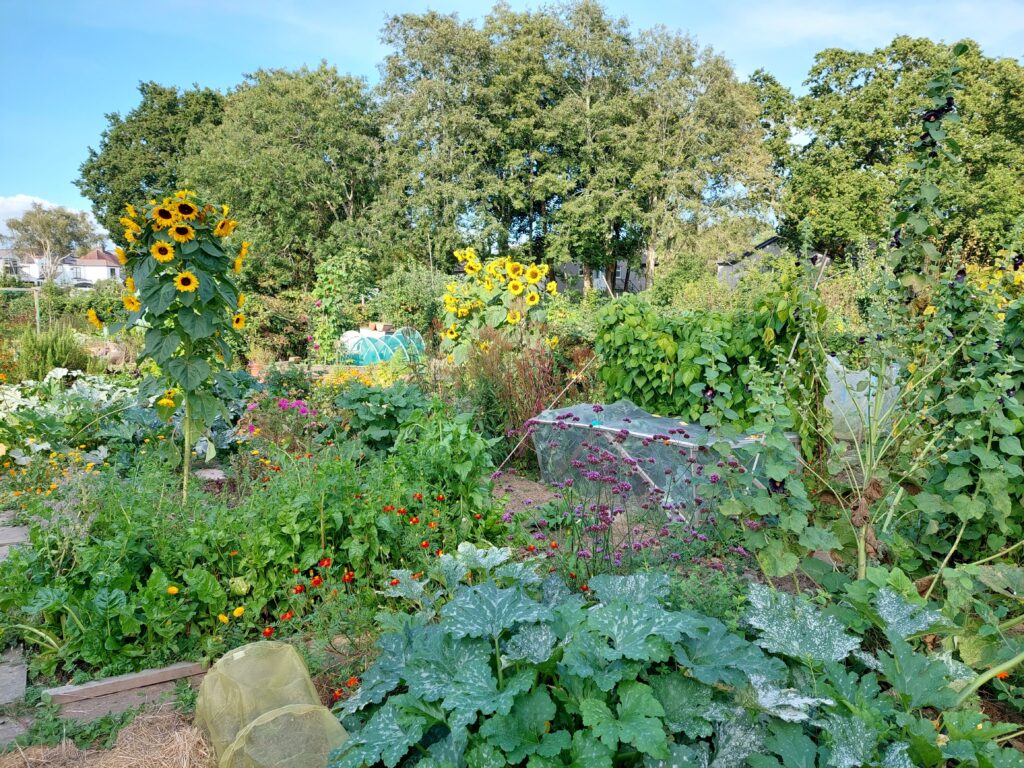
Today I will be talking about mulching, one of my biggest passions within the gardening world, or a lifestyle. I am certain that you will grasp and accept the concept, as it really is a sustainable and completely natural process with many benefits. I have been deep mulching for many years (over 10) and I have gained great results and successes. I also have experience with mulchin in two completely different climates- Mediterranean hot and dry, and UK wet and mild gardening seasons. These opposite experiences have taught me a lot and I give myself a right to present this idea as a sustainable permaculture way forward.
Mulching is covering soil with organic or non-organic materials to prevent weeds from growing, retain moisture in the soil, minimise the labour needed to maintain the garden, protect the soil from elements, and if you are using organic mulches- to boost wildlife and keep constantly feeding the soil as the mulch decomposes. If you take a look in Nature- mulch is everywhere. A woodland floor full of dead leaves, old last year`s growth on unmanaged wild meadows, fern leaves protecting the crown, pine needles floor in a conifer forest, etc.
Organic mulch can be hay (wild meadow plants), straw (crops such as wheat), wood chip, off cuts from the garden, basically anything that will eventually decompose and feed the soil
Non organic can be carpets, plastic membranes, sheets, etc
Decorative mulch can be pebbles, paving, stones etc.
In this blog, I will, of course, focus on organic mulches because of the many benefits they provide. Also, it is completely natural to keep all your “green waste” in your garden. This is such a valuable asset once broken down and turned into good soil. I have deliberately put garden waste into quotation marks, because it is not a waste, it is an organic matter that will keep the garden providing amazing results if used correctly.
A long story short- I had the allotment and within 4 years, I have applied more than 120 bales of hay. Yes, 120 bales of hay. The seasons were easy for me, because mulch worked for me. I`ve observed people around my plot, killing their back digging the weeds, fighting to keep the allotment alive. I was sitting in my foldable chair with a cuppa, enjoying the garden and the Life happening before me. The balance was right and the system literally worked for me. I obviously had to keep supplying mulch and plant the plants, but once established, there was very little to do to keep the garden going. In the autumn, I would cut all those annuals into 30 cm pieces and lay them down- they became mulch themselves.
The same principle is used in your garden, with a small addition- electric mulcher which chops your green waste into fine mulch, which not just provides benefits, but also looks decorative in your borders. So, pretty much everything I cut down will be reused in the garden. I will rarely use the green bin, why would we give such a valuable asset to someone else?
The great misconceptions
Talking to many people about the method, I have realized the pattern of concerns, so let me break the myths, based on my experience and research I`ve done.
Nitrogen- people think that mulch will trap the nitrogen in the soil. That is true, to a certain extent. The process of decomposing will temporarily trap the Nitrogen during breaking down, but it will be released into the soil when the organic matter is decomposed. The main rule is not to dig the mulch in the soil. If laid on top, I haven’t experienced any issues. Normally, the lack of nitrogen is visible with yellow and pale leaves.
Slugs- people also think the mulch will increase slugs, which is not true. Slugs are a part of the ecosystem, and we want them in the garden. Not outnumbered, just there, controlled. There are a few ways of controlling slugs during a season, and I must say that regular management is needed, with or without mulch. Let me point this fact out- slugs will hide between the mulch and the soil during the day. Which means that you can simply lift the mulch and collect them. If there is no mulch, slugs will dig into the soil and you`ll have to wait for the night to collect them with the torch. This is obviously one of the methods, but very effective with immediate effect.
Seeds- many people say that seeds within the mulch (especially if you use hay like I did) will germinate and turn the area into a meadow. I never had that problem because mulch needs to be deep enough to prevent seeds from germinating through.
I tried to compress the story into this easily readable blog, but for those who want to know more, you can find a lot of useful information in this YouTube video.