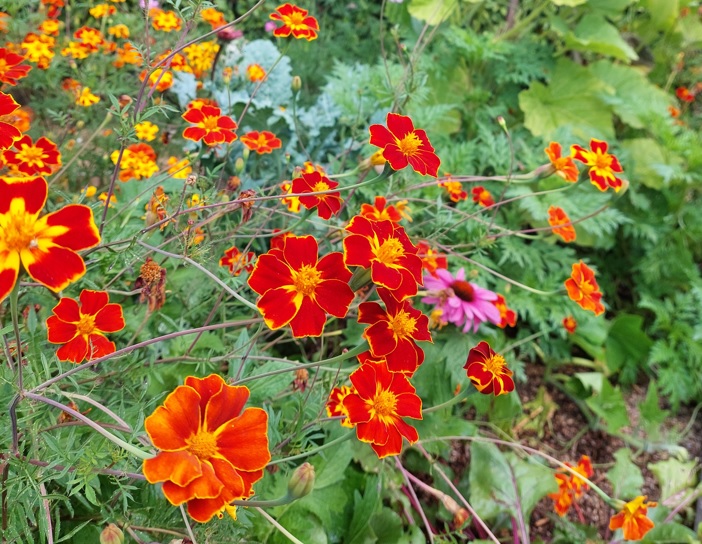
Tagetes, Marigolds, African marigolds or commonly known as French marigolds- my absolutely favorite flowers which I kept growing for years, saving my own seeds. And two years ago, they decided to cross pollinate with other marigolds in the area giving me big round orange or yellow flowers. Which I didn`t like. My disappointment was huge, as I didn`t have any more old seeds. They were too old to germinate, and my despair to find them again was beyond comprehension. I googled, used ChatGPT, explanations to find them. I looked online, in garden centers and kept spying on other gardeners hoping someone might have them. No success.
I have seen a lot in life, and I do understand that often the end means just another beginning. Of something else, perhaps. So, I accepted that I lost those lovely flowers and have moved on. Then one day, I walked into my client`s greenhouse, and there they were, leaning towards me, through some kales, as if they tried to reach me. The wave of excitement was enormous, but I had to confirm to myself first that those are THE marigolds. They have bright dark red-orange-mahogany color on top of their petals, and very strong yellow underneath. And yes, there were showing off before me with all their perfect beauty. And the client peacefully and confidently said “oh yes, Marigolds Buring embers”.
Why do I love them so much? Because they are resilient. Beautiful, strong, yearning for light, progression and growth. Yet fragile, soft so much that they put Persian silk into shame. They are perfect annual cottage garden flowers, featuring fantastic displays when planted in numbers. And a source of nectar for insects. Let`s not forget that around 80% of our food is pollinated by bugs.
The cycle starts in late March when I sow seeds in trays. I compress compost with my hand, sprinkle seeds and cover them with more loose compost. Water them and wait to see the first signs of life. I leave them in the same tray until they are around 10 cm high and then I plant them into the final position, 10-15 cm apart. If you have slugs, they`ll have to be managed before planting. I use organic palettes, approximately a week before planting, beer traps, or nematodes, if the border is big and is not covered with mulch. Always plant more, in case if you lose some. They like compost rich soil, so please, keep feeding your soil annually. Which is the core principle in permacultural organic gardening.
Once planted, I`d sprinkle more slug palettes and hope for the best. They grow fast, and around July, they`ll start blooming and growing. It is a good and recommended practice to dead head them, to transfer seed-producing energy into growth and flowering. But remember, leave some flowers to develop into seeds before the end of season. I read somewhere that the plant from which you will collect seeds, shouldn`t be harvested or dead headed at all, to avoid stressing it. I follow this rule with my runner beans; I always have a few tripods for seeds collection only.
As they bloom, they really make me happy- make me slow down and take this beauty in. I cannot grasp this design, it tickles my mind and I am obsessed by them. I turn petals, observe them and keep asking myself how. And who created this art?
As days get colder, they will keep flowering, extending the season and colours. The landscape is now probably autumnal-grey, Life gets introverted preparing for winter. But they bloom, breaking the rules for another few weeks. Then they`ll start to deteriorate and finally become mulch themselves.
Please don`t forget to leave seeds on plants until pods are completely dry and brittle. When you cut them off, take off dry petals and crack the pod- sprinkle seeds in a tray and let them dry. I keep them in a cardboard bag so they can breathe over the winter. And then, after a long grey winter, sometime in March, I fetch the bag saying “moje kadife 2026”, my marigolds 2026, once more, ready for the beauty once again.